Running Out of Time
DOI:
https://doi.org/10.33011/cuhj20264873Keywords:
feminsism, societal expectations, gender inequality, patriarchyAbstract
Artist Statement
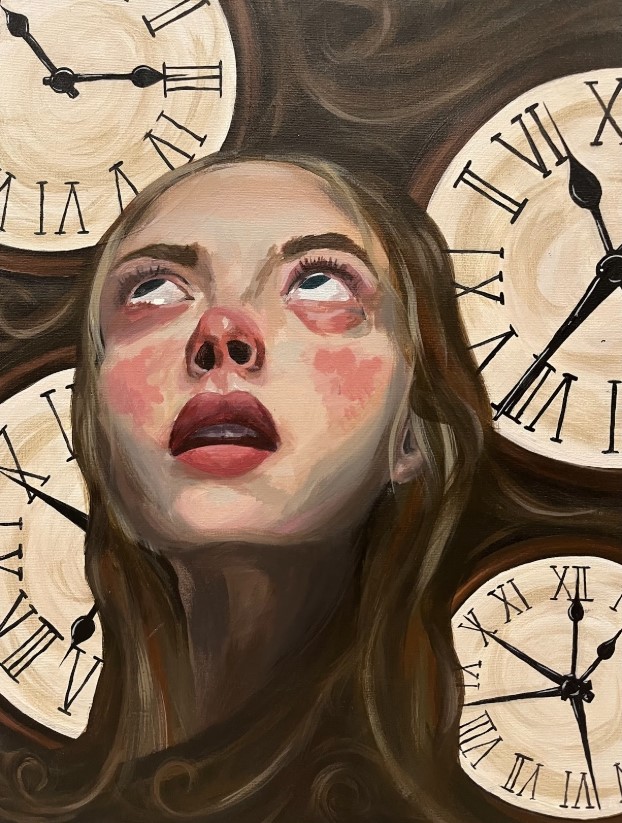
This piece is titled "Running Out of Time.” I wanted to animate the pressure from society to achieve--which is called the social clock--that women receive unproportionally to men. As Yelnur Shildibekov, PhD wrote in his article Social Clock in Psychology: Definition, Origin & Impact, “The very definition of the social clock dictates implicit societal expectations and puts pressure on individuals to achieve these milestones within a specified time frame” (2024). The reference I used is a still image of Amanda Seyfried in the movie Jennifer’s Body, directed by Karyn Kusama. I used acrylic paint as my medium.
The woman in the artwork symbolizes all women suffering under patriarchal societies. Surrounding her are four clocks, three of which are intentionally distorted—one with Roman numerals out of order, another with extra hands, and a third with its numbers flipped upside down. Her gaze is fixed on the only “normal” clock, which represents the pressure on women to conform to what society deems the perfect timeline. In my view, some of the most demanding expectations include marrying and having children relatively early, which often pushes education and career aspirations aside. The distorted clocks represent alternative life paths that diverge from these norms; although they still mark time, their confusing and unsettling designs reflect society’s scorn for those who don’t adhere to traditional gender expectations. The woman’s hair, wrapped and tangled around the clocks, symbolizes the struggle women face when trying to untether themselves from patriarchal constraints. The floating clocks suggest that these social roles are fabricated constructs—made real only through collective belief and behavior. The woman’s expression of apprehension, along with her drained complexion, conveys the emotional and physical exhaustion caused by the pressures surrounding her. Finally, the overlapping of the figures within the tight composition creates a sense of claustrophobia, mirroring the anxiety of feeling as though one is never moving quickly enough to meet societal expectations. There is no best path to choose in terms of this painting. No clock is broken, but the perception of how they’re portrayed clearly implies it. As this painting highlights the struggles of women in a patriarchal society, the change I’d want to make is to give women the same freedom men have to create a life for themselves. In the United States specifically, this is not a change that can be addressed through legislation--the oppression is purely social. Therefore, the only change that can address the issue is a reframing of expectations for women. A change in beliefs enacted worldwide would ensure women are given equal opportunities to pave their way in life, without the ticking clocks of expectations distracting them from their passions.
Downloads
Published
How to Cite
Issue
Section
License
Authors whose work is accepted and who publish with The University of Colorado Honors Journal agree to the following terms:
1. The Author retains copyright in the Work, where the term “Work” shall include all objects that may result in subsequent electronic or print publication or distribution.
2. Upon acceptance of the Work, the author shall grant to the Publisher the right of first publication of the Work.
3. The Author shall grant to the Publisher and its agents the nonexclusive perpetual right and license to publish, archive, and make accessible the Work in whole or in part in all forms of media now or hereafter known under a non-exclusive license, which grants the Journal the right to copy, distribute, and transmit the Work under the following conditions: a. Right of publication in the print format of the journal; b. Right of publication in the online and/or digital format of the journal; c. Right to use in promotional or other journal-related activities, as defined by the journal.
4. Upon Publisher’s request, the Author agrees to furnish promptly to Publisher, at the Author’s own expense, written evidence of the permissions, licenses, and consents for use of third-party material included within the Work, except as determined by Publisher to be covered by the principles of Fair Use.
5. The Author represents and warrants that: a. the Work is the Author’s original work; b. the Author has not transferred, and will not transfer, exclusive rights in the Work to any third party; c. the Work is not pending review or under consideration by another publisher; d. the Work has not previously been published; e. the Work contains no misrepresentation or infringement of the Work or property of other authors or third parties; and f. the Work contains no libel, invasion of privacy, or other unlawful matter.
6. The Author agrees to indemnify and hold Publisher harmless from Author’s breach of the representations and warranties contained above, as well as any claim or proceeding relating to Publisher’s use and publication of any content contained in the Work, including third-party content.
11-August-2014