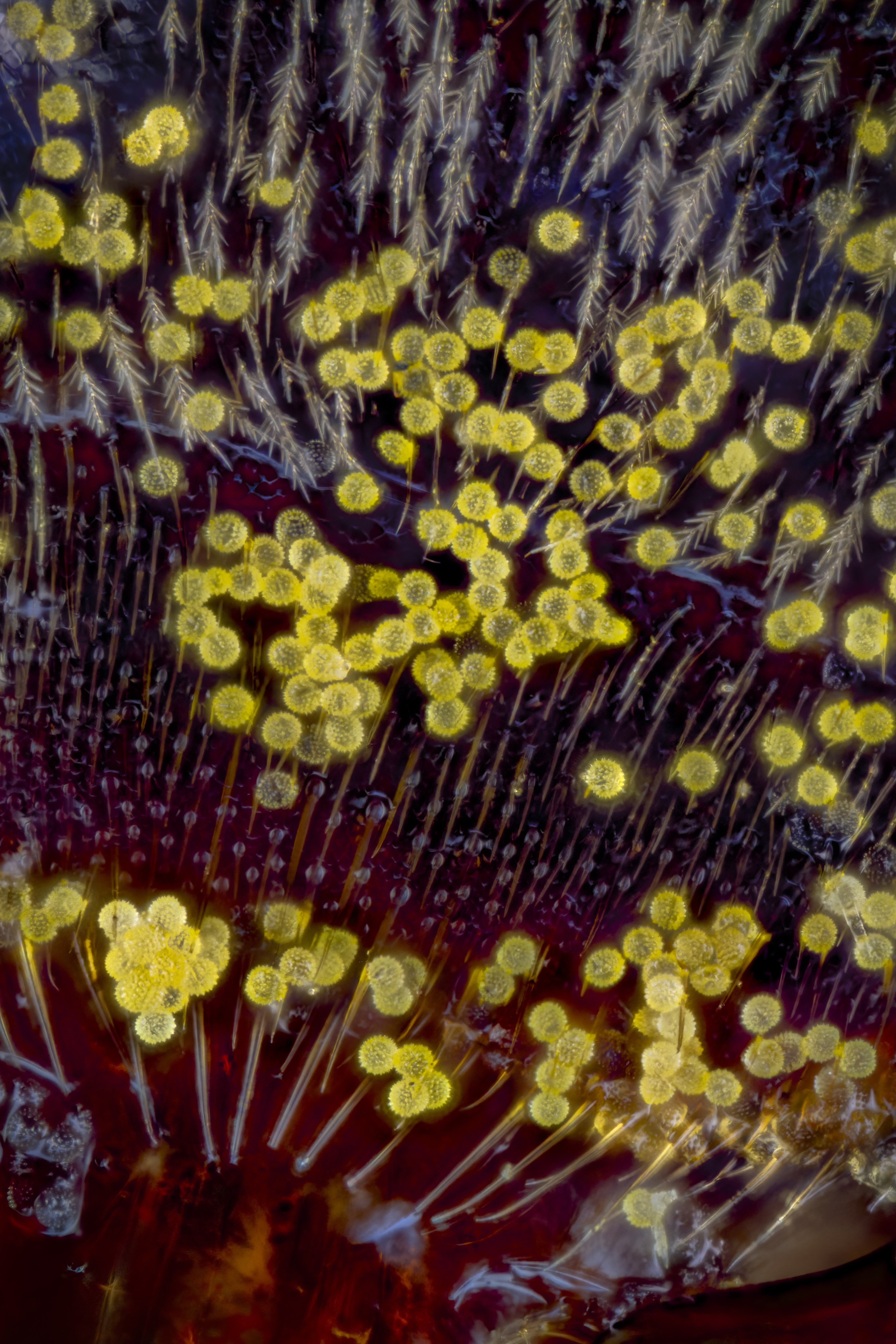
Honey bee face with pollen
Apis mellifera, 2024, Boulder, Colorado
DOI:
https://doi.org/10.33011/cuhj20253545Keywords:
bee, pollen, microscopyAbstract
Insects hold vital roles in ecosystems. Pollinators, parasites, predators, herbivores, and decomposers are just a few examples of typical specialties. This series of photographs represents each of these groups, with an attention to close-up, sometimes even microscopic details that would otherwise go unnoticed. In a world of unprecedented change, insects are becoming more important than ever as we try to solve complex ecological problems.
These CU Museum of Natural History Entomology Collection specimen photographs are stacks of many images. At this level of magnification, only a small plane is in focus, so ~100-200 images are taken from front to back to encompass the entire plane of the insect. As the magnification increases, sometimes only a few micrometers of a specimen are in focus at any given time, and many images are required to create a fully focused image.
With these images, I hope to provide a new perspective on insects and their stunning features. Compound eyes, eloquent wing scales, hairs that carry pollen, and incredible mimicking structures depict the epic level of biodiversity and specialization in the insect world. My goal is that someday, with the help of photographs, more people will value insects for their beauty, biodiversity, and necessary ecological importance.
Downloads
Published
How to Cite
Issue
Section
License
Authors whose work is accepted and who publish with The University of Colorado Honors Journal agree to the following terms:
1. The Author retains copyright in the Work, where the term “Work” shall include all objects that may result in subsequent electronic or print publication or distribution.
2. Upon acceptance of the Work, the author shall grant to the Publisher the right of first publication of the Work.
3. The Author shall grant to the Publisher and its agents the nonexclusive perpetual right and license to publish, archive, and make accessible the Work in whole or in part in all forms of media now or hereafter known under a non-exclusive license, which grants the Journal the right to copy, distribute, and transmit the Work under the following conditions: a. Right of publication in the print format of the journal; b. Right of publication in the online and/or digital format of the journal; c. Right to use in promotional or other journal-related activities, as defined by the journal.
4. Upon Publisher’s request, the Author agrees to furnish promptly to Publisher, at the Author’s own expense, written evidence of the permissions, licenses, and consents for use of third-party material included within the Work, except as determined by Publisher to be covered by the principles of Fair Use.
5. The Author represents and warrants that: a. the Work is the Author’s original work; b. the Author has not transferred, and will not transfer, exclusive rights in the Work to any third party; c. the Work is not pending review or under consideration by another publisher; d. the Work has not previously been published; e. the Work contains no misrepresentation or infringement of the Work or property of other authors or third parties; and f. the Work contains no libel, invasion of privacy, or other unlawful matter.
6. The Author agrees to indemnify and hold Publisher harmless from Author’s breach of the representations and warranties contained above, as well as any claim or proceeding relating to Publisher’s use and publication of any content contained in the Work, including third-party content.
11-August-2014